
Tessellations: The Art and Mathematics of Tiling the Plane
· 4 min read
Drafted with AI assistance. Spot a mistake? Email hello@geopatternlab.com.
A tessellation is the seamless covering of a flat surface using one or more geometric shapes without overlaps or gaps. Rooted in both rigid geometry and expressive design, tilings reveal how simple rules of symmetry can transform flat space into endlessly captivating surfaces.
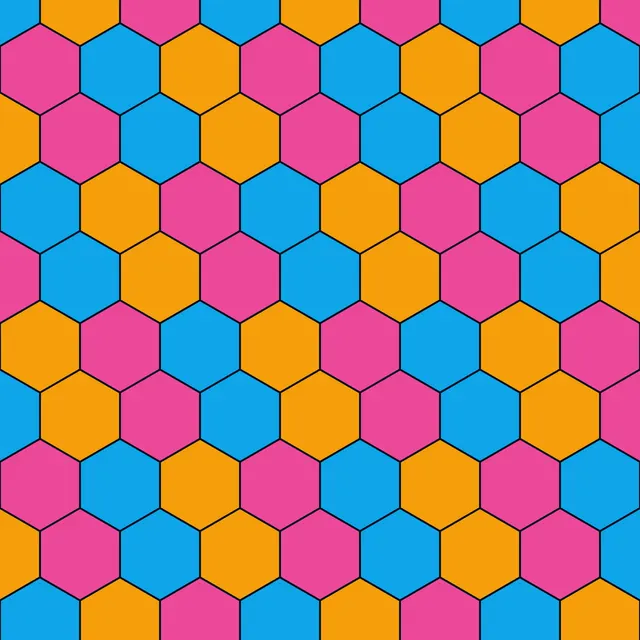 Try Tessellation StudioThe three regular tilings — squares, triangles and hexagons — in three-color patterns.
The Geometry of the Plane: What Makes a Tessellation Work
The word tessellation traces back to the Latin word tessella, referring to the small stone, clay, or glass cubes used in ancient mosaics. Mathematically, tiling a two-dimensional Euclidean plane requires a strict balance of angles: around any shared vertex where corners meet, the interior angles of the adjacent shapes must sum to exactly 360 degrees. If the sum is less than 360 degrees, a gap forms; if it exceeds 360 degrees, the shapes buckle or overlap.
Because of this angle requirement, only three regular polygons can form a monohedral tiling where every tile is identical in shape and edge length. Equilateral triangles have interior angles of 60 degrees, so six meet at every vertex. Squares feature 90-degree angles, meeting in sets of four. Regular hexagons carry 120-degree angles, joining cleanly in groups of three. Other regular polygons, like regular pentagons with their 108-degree angles, cannot divide 360 evenly and therefore fail to cover a flat plane on their own.
Semi-Regular Tilings and Archimedean Diversity
When designers relax the rule of using only a single polygon, a rich field of semi-regular, or Archimedean, tilings emerges. A semi-regular tessellation uses two or more distinct types of regular polygons while keeping every single vertex identical in arrangement. There are exactly eight semi-regular tilings possible in the Euclidean plane.
These arrangements balance contrasting forms, such as alternating squares and triangles, or interlocking octagons with small filler squares. By naming vertices according to the sequence of shapes meeting around them, geometers can categorize every configuration cleanly. For example, a common floor pattern composed of octagons and squares possesses the vertex configuration 4.8.8, indicating that one square and two regular octagons converge at each point.
From Geometry to Metaphor: M.C. Escher's Dynamic Tilings
While traditional floor and wall tilings rely on straight edges, Dutch graphic artist M.C. Escher revolutionized tessellations by turning abstract geometric units into living motifs like birds, fish, lizards, and horsemen. Escher became deeply fascinated by the intricate Moorish tilework of the Alhambra palace in Spain, yet he sought to replace pure geometric abstraction with recognizable figures.
Escher achieved this by exploiting fundamental planar transformations: translation, rotation, reflection, and glide reflection. By cutting a contour out of one side of a basic geometric tile and welding the identical shape onto the opposite side, the surface area remains constant while the profile morphs. Through careful color alternation and interlocking silhouettes, Escher established rhythmic relationships between positive and negative space, where the boundary of one creature simultaneously defines the edge of another.
Aperiodic Order and Non-Repeating Horizons
For centuries, mathematicians assumed that any set of shapes capable of covering an infinite plane must do so periodically, meaning the entire arrangement would align with itself under a standard shift or translation. In the 1960s and 1970s, this assumption was shattered with the discovery of aperiodic tilings, which tile the plane completely without ever settling into a repeating grid.
British mathematician Roger Penrose introduced famously economical sets of aperiodic tiles, such as a pair of rhombuses with specific internal angles or the complementary kite and dart shapes. When governed by matching rules that dictate how adjacent edges connect, Penrose tilings produce infinite variations displaying fivefold rotational symmetry. Decades after their mathematical discovery, physicists observed identical structural symmetries in real-world quasicrystals, proving that non-periodic tiling rules govern real atomic matter as well as visual art.
Designing Tilings in Modern Art and Digital Graphics
Today, tessellation principles serve as foundational structures in graphic design, 3D modeling, textile fabrication, and architectural skin engineering. Algorithmic tiling engines permit artists to warp underlying lattices dynamically, producing kinetic gradients, modular patterns, and optical illusions.
Whether creating a simple isometric cube layout, crafting an interlocking quilt block, or exploring procedural tile maps for interactive digital worlds, understanding the angle constraints and symmetry groups of the plane allows designers to construct complex, coherent structures out of elementary geometric rules.
Frequently asked questions
Why can't regular pentagons tile the flat plane by themselves?
A regular pentagon has internal angles of 108 degrees. Because 360 is not evenly divisible by 108, three pentagons meet at a vertex with a 36-degree gap remaining (324 degrees total), while four pentagons would overlap (432 degrees). As a result, regular pentagons cannot cover a flat surface without leaving gaps.
What is the difference between regular and semi-regular tilings?
A regular tiling uses only one type of regular polygon (triangles, squares, or hexagons) with identical vertices throughout. A semi-regular tiling uses two or more types of regular polygons, but every vertex in the tiling still shares the exact same sequence and arrangement of shapes.
What makes Penrose tilings different from traditional mosaic patterns?
Traditional mosaic patterns are periodic, meaning their pattern repeats at regular intervals and can be shifted across a grid to align with itself. Penrose tilings are aperiodic: they cover the plane completely without any gaps or overlaps, yet they never repeat their configuration periodically.