
Intersection
Run a four-way junction with fixed, actuated or max-pressure signals or an all-way stop, and count the delay and near misses.
- Car
- In a conflict
- Pedestrian
- Green
- Yellow
- Red
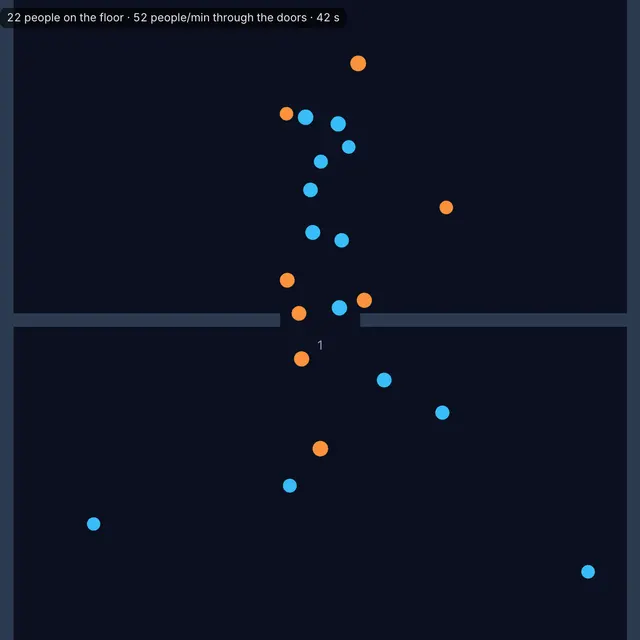
Cars follow their lane, keep their distance and stop at the line while they may not go; pedestrians cross on their walk interval. Two road users that would meet within 1.5 s turn red, a conflict. Tap an approach or a crosswalk to close or open it; Rerun plays the same traffic again with your changes.
How is Intersection working for you?

About Intersection
- Controls
- Fixed-time, actuated, max pressure, all-way stop
- Car following
- Intelligent Driver Model, 1.6 s headway
- Conflict
- Time to collision under 1.5 s (SSAM)
- Walk interval
- At least 7 s (MUTCD 2009)
Intersection runs a four-leg junction, one lane each way, with cars arriving at random from every side and pedestrians crossing all four legs. Each car follows its path, left, straight or right, with the Intelligent Driver Model of Martin Treiber, Ansgar Hennecke and Dirk Helbing (2000): it speeds up toward 50 km/h, keeps a safe time headway of 1.6 s to the car ahead, and brakes for a stop line while it may not go or for a crosswalk with someone on it.
Four controls decide who may go. A fixed-time signal splits each cycle between the two roads; an actuated signal ends a green once the road is clear; max pressure, from Pravin Varaiya's 2013 paper, gives every green to the road with the longer queue; an all-way stop sends cars in the order they stopped, and cars whose paths neither cross nor merge go together. Left turns on a green wait for a gap of 4.5 s in the oncoming traffic, and turning cars give way to pedestrians, who walk at 1.3 m/s, the speed Burstedde and colleagues (2001) used for their pedestrian model. Yellow and walk intervals follow the ranges of the MUTCD (2009).
A conflict is a near miss: two road users who would reach the same point within 1.5 s of each other and of now, the threshold the FHWA's Surrogate Safety Assessment Model uses. Both turn red for a moment. The readout counts cars through per hour, their mean delay at the stop line and conflicts per hour; each run adds a row to the Runs table after 15 minutes. Close an approach or a crosswalk by tapping it, and export a PNG, video, GIF or CSV.
How to use Intersection
- Pick a control. Choose Fixed-time signal, Actuated signal, Max pressure or All-way stop. The lights at each stop line show green, yellow or red; an all-way stop shows a stop sign at every approach.
- Set the traffic. Set North-south arrivals and East-west arrivals from 100 to 1,200 cars per hour per approach, the shares of Left turns and Right turns, and Pedestrians from 0 to 600 per hour.
- Time the signal. With a fixed-time signal set the Cycle and the Green split of the north-south road; Yellow and Walk set the change and walk intervals.
- Watch for conflicts. Cars are blue and pedestrians yellow; any two that would meet within 1.5 s turn red for a moment and count as one conflict.
- Close an approach. Tap an approach's lane to stop its traffic, or a crosswalk to close it. Rerun plays the same arrivals again with your changes; Restart draws new arrivals, and Reset returns every setting to its default.
- Compare runs. After 15 minutes of model time each run adds a row to the Runs table: cars through per hour, the mean delay at the stop line, conflicts per hour and the pedestrians' mean wait.
- Export. Save a PNG, a video or GIF, or record the first 30 seconds again. The CSV files hold the mean delay every 10 s and the Runs table, and a share link carries closed approaches and crosswalks.
Frequently asked questions
Which control moves the most traffic?
It depends on how much traffic comes from each side. A fixed-time signal gives each road its share of the cycle whether or not cars are waiting; an actuated signal and max pressure (Varaiya 2013) move the green to where the cars are. Try Rush hour on one road with each control. An all-way stop makes every car stop, so it fills up at lower traffic than a signal.
What counts as a conflict?
Two road users whose paths cross and who would reach the crossing point within 1.5 s of each other and of now. The FHWA's Surrogate Safety Assessment Model uses a maximum time to collision of 1.5 s to count such near misses as a stand-in for crashes, which are too rare to count directly.
How long should a walk signal be?
The MUTCD (2009, Section 4E.06) asks for a walk interval of at least 7 seconds, or 4 seconds where few people walk, followed by a clearance time long enough for someone walking at 3.5 feet per second to reach the far side.
Is the delay real?
It is the model's: the time each car loses reaching the stop line compared with driving there at 50 km/h. The car-following parameters come from Treiber, Hennecke and Helbing (2000); the junction's size, the 50 km/h speed and the 4.5 s gap a turning driver accepts are model settings.
References
- Treiber, M., Hennecke, A., & Helbing, D. (2000). Congested traffic states in empirical observations and microscopic simulations. Physical Review E 62(2), 1805–1824.
- Varaiya, P. (2013). Max pressure control of a network of signalized intersections. Transportation Research Part C 36, 177–195.
- Gettman, D., Pu, L., Sayed, T., & Shelby, S. (2008). Surrogate Safety Assessment Model and Validation: Final Report. FHWA-HRT-08-051, Federal Highway Administration.
- Federal Highway Administration (2009). Manual on Uniform Traffic Control Devices, Part 4. Sections 4D.26 and 4E.06.
- Burstedde, C., Klauck, K., Schadschneider, A., & Zittartz, J. (2001). Simulation of pedestrian dynamics using a two-dimensional cellular automaton. Physica A 295(3–4), 507–525.