
Lenia
A continuous Game of Life on your GPU — worms, coral and bubble lattices self-organize from noise.
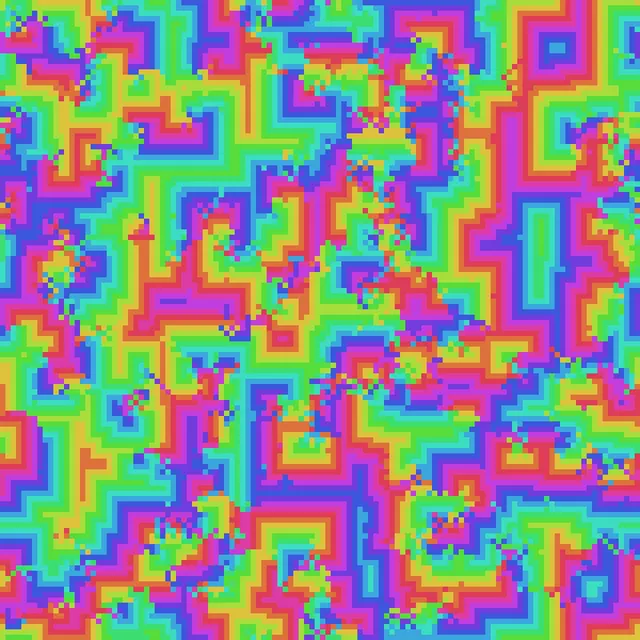
A continuous Game of Life on your GPU: worms, bubbles and coral self-organize from random soup. Drag to paint life; tweak μ and σ in small steps.
How is Lenia working for you?

About Lenia
Good for: Late at night
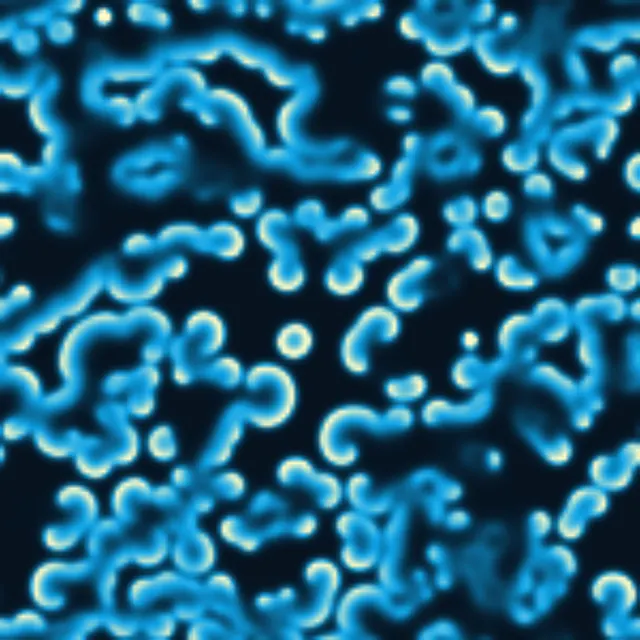
Lenia is a continuous cellular automaton invented by Bert Wang-Chak Chan — a smooth, high-resolution cousin of Conway's Game of Life. Instead of cells that are simply alive or dead, every cell holds a value between 0 and 1, and instead of counting eight neighbors, each cell looks at a smooth ring-shaped neighborhood. From those continuous rules, random noise self-organizes into worms, bubble lattices, coral, labyrinths and tissue-like textures that keep shifting and healing.
Each step, the grid is blurred with a ring kernel of radius R (optionally with several concentric rings), and a bell-shaped growth function decides whether each cell grows or decays: cells whose surroundings are close to the target density μ grow, others shrink, with σ setting how picky the rule is and T setting the time resolution. Lenia's most famous species, such as the Orbium glider, live in very narrow parameter ranges and need precisely shaped seeds — the Orbium rule preset lets you experiment with its exact parameters.
This simulator runs on your GPU with WebGL2, computing hundreds of kernel samples for every cell every frame, and falls back to a smaller CPU grid on devices without float textures. Switch rule presets, tweak the parameters live, paint new life or erase it with the brush, change the color map, and export a high-resolution PNG or record a video or GIF.
How to use Lenia
- Pick a rule. Choose a preset such as Worms, Bubble lattice or Coral. The grid is seeded with random noise blobs that self-organize under the rule.
- Paint life. Click and drag on the canvas with Brush set to Add to drop new noise, or set it to Erase to wipe areas; while paused, the brush paints without advancing the model. Press Randomize for another species, start strength, color map and soup.
- Tune the rule. Adjust Growth center μ and Growth width σ in small steps — Lenia patterns change sharply within tiny ranges. Kernel radius R scales the structures; T sets the time step; Start strength sets how dense the starting noise is.
- Change the look. Switch the color map, grid size and simulation speed.
- Capture. Export a high-resolution PNG or record a video or GIF. Share copies a link to your exact settings.
Frequently asked questions
What is Lenia?
Lenia is a family of continuous cellular automata created by Bert Wang-Chak Chan. It generalizes Conway's Game of Life to continuous states, space and time, and is known for hundreds of self-organizing 'species' that resemble microscopic organisms.
How is Lenia different from the Game of Life?
In the Game of Life cells are 0 or 1 and update by counting 8 neighbors. In Lenia cells take any value from 0 to 1, the neighborhood is a large smooth ring, and growth follows a smooth bell curve, so patterns flow and heal instead of flipping in discrete jumps.
Why does everything die or fill the screen?
Lenia rules are very sensitive. If everything fades, lower σ slightly, move μ, or raise Start strength; if the grid fills up with a maze, lower Start strength or move μ the other way. Reloading a preset restores known-good values.
Can I find the Orbium glider here?
The Orbium rule preset uses Orbium's published parameters (R 13, μ 0.15, σ 0.015). Orbium itself only forms from carefully shaped starting patterns, so random seeds usually die or explode — painting small blobs at different strengths is an experiment in how fragile these creatures are.
Does Lenia need a GPU?
It runs best on a GPU via WebGL2, which nearly all modern desktop and mobile browsers support. If float textures are unavailable, the simulator automatically switches to a smaller CPU grid.
Can I leave it running at night?
Yes. Pick a preset, lower Speed and choose a dark Color map, then press Full screen and lower the screen brightness. It makes no sound. Creatures grow, move and sometimes die out; press Randomize to start again.
References
- Chan, B. W.-C. (2019). Lenia: Biology of artificial life. Complex Systems 28(3), 251–286.