
Stadium Exit
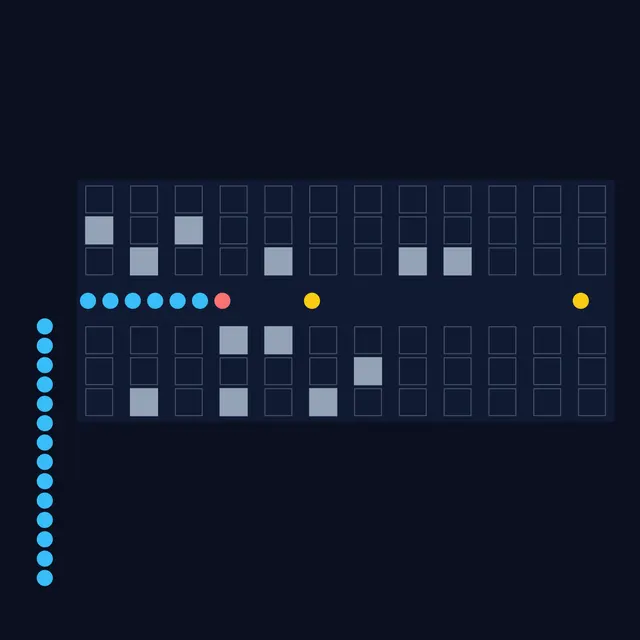
Empty a stadium seating section through stepped aisles and vomitories, and see what sets the time to the last person out.
- Person
- On the stairs
- Seats
- Stairs
- Vomitory
Each person moves at most one cell of 0.4 m every 0.3 s, toward the nearest vomitory and along the trail others leave; on the stairs a step can fail. Tap a seat, a stair or a vomitory cell to close or open it while people leave; Rerun starts again with that layout.
How is Stadium Exit working for you?

About Stadium Exit
- Model
- Floor-field cellular automaton
- Cell
- 40 × 40 cm, one person
- Step
- 0.3 s (Burstedde et al. 2001)
- Trail
- Fades 0.3 and spreads 0.3 per step
Stadium Exit empties one seating section of a stadium: rows of seats split into blocks by stepped aisles, a walkway behind the top row, and vomitories, the passages that lead from the stands to the concourse. Each person follows the floor-field cellular automaton of Carsten Burstedde, Kai Klauck, Andreas Schadschneider and Johannes Zittartz (2001), in the form Ansgar Kirchner and Andreas Schadschneider used for evacuations (2002): the floor is cut into cells of 40 × 40 cm that hold one person each, and every 0.3 s each person steps into one of the four cells that share an edge with theirs, or stays.
The step is chosen at random, weighted by two fields. The static field grows toward the nearest vomitory, counted in cells walked around the seats; the dynamic field is a trail each step leaves behind, which fades by 0.3 and spreads by 0.3 every step. Static coupling and Dynamic coupling set how strongly each field pulls. Everyone moves at once, nobody enters a cell that was occupied when the step began, and when two people pick the same cell one of them, chosen at random, gets it. On the stairs a step up or down succeeds only with the Stair step chance.
The readout gives the time, the people still in the section and each vomitory's flow over the last 30 s. The chart plots the people left against the fastest emptying the rules allow, and each run adds its time to empty to the Runs table. Tap a seat, a stair or a vomitory cell to close it, and export a PNG, a video, a GIF or CSV.
How to use Stadium Exit
- Pick a section. Choose Two vomitories, One vomitory, Wide aisles, Staged release or Steep stairs. Each preset sets every control.
- Shape the section. Set Rows from 8 to 30, Seats per row from 10 to 40, Aisles from 1 to 4, Aisle width from 0.4 to 1.2 m and Vomitories from 1 to 3, each 1.2 m wide.
- Set the release. All at once lets everyone stand at the start. By block lets the rows leave in blocks of five, the back rows first, each block 30 s after the one before.
- Tune the walkers. Static coupling sets how directly people head for a vomitory, Dynamic coupling how closely they follow others, and Stair step chance how often a step on the stairs succeeds.
- Close cells. Tap a seat, a stair or a vomitory cell to close or open it while people leave: they take the new routes, anyone cut off stays put, and the chart drops its fastest line once the layout changes after the start. Rerun starts again with the layout and the same random choices, Restart clears it, and Reset returns every setting to its default.
- Compare runs. When the section is empty the run adds a row to the Runs table: the time to empty and the mean flow per vomitory.
- Export. Save a PNG, record 8 seconds, or record the full run: it empties the same section again from the start and records until the last person is out. The CSV files hold the people left every 2 s and the Runs table, and a share link carries closed cells.
Frequently asked questions
What is a vomitory?
A passage below or behind a tier of seats in an amphitheatre or a stadium through which large crowds can leave quickly at the end of an event. The Latin word vomitorium comes from the verb vomere, to spew forth.
What slows the section most?
In the model, the rows and the aisles. People file out of a row into an aisle one cell at a time, and no cell passes more than one person every two steps; failed steps on the stairs slow the aisles further. A second vomitory helps only once the aisles bring people faster than one vomitory passes them. Compare the presets in the Runs table.
What is the fastest possible line?
Everyone must cross the back wall through the aisles and leave through a vomitory. A person who enters a cell is still in it when the next step begins, so each cell passes at most one person every two steps, and the narrower of the two openings sets the fastest emptying the rules allow. Walking to the aisles, waiting for gaps and failed steps keep every run above it.
Are the times real?
They are the model's. The cell size and the 0.3 s step come from Burstedde and colleagues (2001), who matched one cell per step to an average walking speed of about 1.3 m/s; the couplings lie in the ranges Kirchner and Schadschneider (2002) studied; the layout, the stair step chance and the release gap are model settings. The model has not been checked against timed stadium exits.
References
- Burstedde, C., Klauck, K., Schadschneider, A., & Zittartz, J. (2001). Simulation of pedestrian dynamics using a two-dimensional cellular automaton. Physica A 295(3–4), 507–525.
- Kirchner, A., & Schadschneider, A. (2002). Simulation of evacuation processes using a bionics-inspired cellular automaton model for pedestrian dynamics. Physica A 312(1–2), 260–276.