
Airplane Boarding
Board a single-aisle plane five ways, from random to back to front, and see why passengers stowing bags block everyone behind them.
- Walking
- Stowing bags
- Shuffling into a seat
- Seated
- Seat to fill
- Empty seat
Passengers walk down the aisle to their row, stow their bags and sit; anyone stowing or squeezing past seated passengers blocks the aisle behind them. Tap a seat to empty or fill it while passengers board; Rerun boards the same seat map from the start.
How is Airplane Boarding working for you?
About Airplane Boarding
- Methods
- 5, as Steffen and Hotchkiss tested them in 2012
- Fastest measured
- Steffen method, 3:36 for 72 passengers
- Slowest measured
- Blocks of rows, 6:54
- Aisle
- Two cells per seat row
Airplane Boarding fills a single-aisle plane, three seats on each side of one aisle, one passenger at a time. Passengers walk down the aisle to their row, stow their carry-on bags and sit, and anyone stowing a bag or squeezing past seated passengers blocks the aisle behind them. The aisle is a row of cells, two per seat row, as in Jason Steffen's 2008 model, and each step every passenger who can moves one cell.
The order decides how much of that waiting happens at once. In 2012 Jason Steffen and Jon Hotchkiss timed five orders with 72 passengers in a mock fuselage of 12 rows: the Steffen method, which seats every other row with window seats first, took 3 minutes 36 seconds; window, middle and aisle groups (Wilma) 4:13; random boarding with assigned seats 4:44; strict back to front 6:11; and blocks of rows 6:54. Back to front is slow because the passengers in line all head for the same few rows and stow their bags one after another.
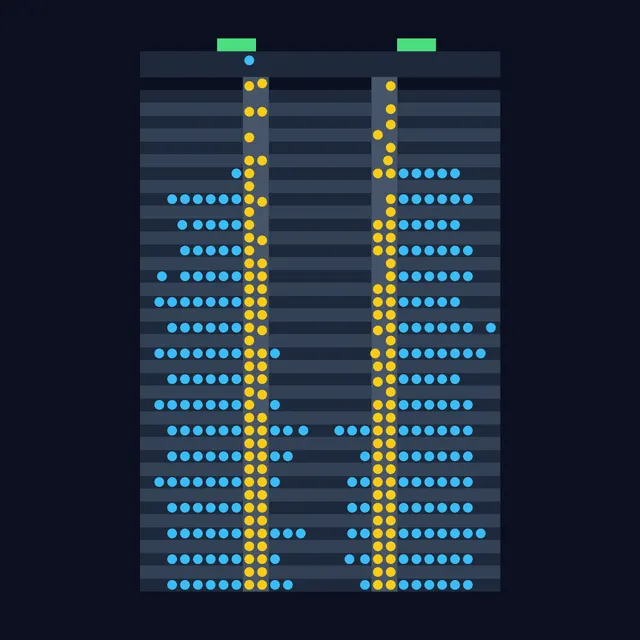
The chart counts seated passengers against time and marks the time Steffen and Hotchkiss measured for the method when the plane has their 12 full rows. Each finished boarding adds a row to the Runs table. Tap seats to empty them, add a rear door, and export a PNG, video, GIF or CSV. The walking pace, stow time and seat shuffle time are model settings.
How to use Airplane Boarding
- Pick a method. Choose Random, Back to front, Blocks, Wilma or Steffen. Back to front boards row by row from the back, window to aisle; Blocks boards the back third, then the front third, then the middle; Wilma boards window seats, then middle, then aisle; Steffen boards every other row from the back, one side at a time, window seats first.
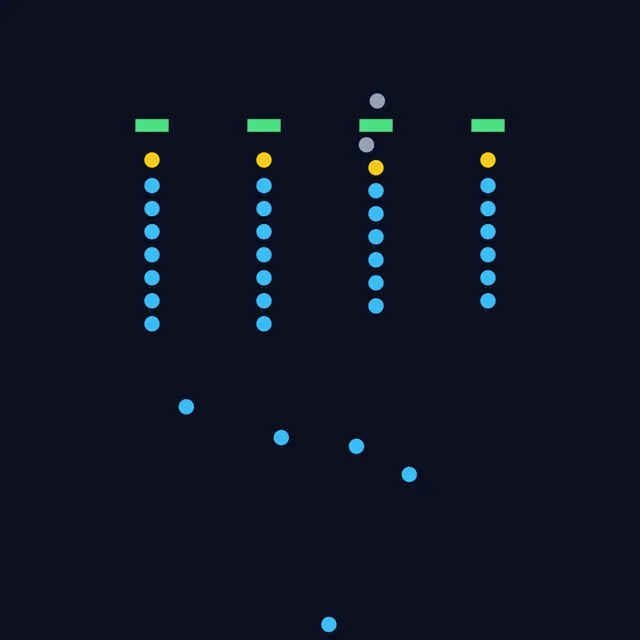
- Watch the aisle. Blue passengers are walking, yellow ones are stowing bags and red ones are waiting for seated passengers to let them in; anyone stopped blocks everyone behind. The counter shows the time, the seated passengers and how many are in the aisle.
- Read the chart. Seated passengers climb toward the total. With 12 full rows, the vertical line marks the time Steffen and Hotchkiss measured for the method in 2012.
- Change the plane. Set Rows from 6 to 30, Load from 50 to 100%, Doors to Front or Front and rear (the back half of the rows boards at the rear) and Bags from 0 to 2 per passenger.
- Tune the model. Stow time is the seconds to stow one bag into empty bins, doubling as the bins fill; Seat shuffle is the seconds each seated passenger in the way takes to let someone in.
- Empty seats. Tap a seat to empty or fill it while passengers board: the passenger of an emptied seat leaves with their bags, and a filled seat's passenger joins the end of the line at their door. Rerun boards the same seat map again from the start; Restart draws a new one, and Reset returns every setting to its default.
- Compare runs. Each finished boarding adds a row to the Runs table with its time and the settings that differ between rows. Reset clears it.
- Export. Save a PNG, a video or GIF, or record the full run. The CSV files hold the seated passengers every 2 s and the Runs table, and a share link carries the seat map.
Frequently asked questions
Which boarding method is fastest?
In Steffen and Hotchkiss's 2012 test with 72 passengers, the Steffen method: 3 minutes 36 seconds, against 4:44 for random boarding and 6:54 for blocks of rows. Passengers two rows apart can stow bags at the same time, and window seats go first, so nobody has to stand up for anyone.
Why is back-to-front boarding slow?
Because the passengers in line all want the same few rows. Only one or two can stow a bag at a time while the rest of the aisle waits; in the 2012 test strict back to front took 6:11, slower than random boarding at 4:44.
What is the Wilma method?
Window, middle, aisle: window passengers board first, then middle seats, then aisle seats, so no seated passenger is ever in the way. It took 4:13 in the 2012 test, between the Steffen method and random boarding.
Are the times in the tool real?
The orders and the rules follow the studies; the walking pace of 0.4 m per 0.5 s, the stow time and the seat shuffle time are model settings, chosen so the five methods rank as measured. The chart marks the measured times beside the model's.
References
- Steffen, J. H. (2008). Optimal boarding method for airline passengers. Journal of Air Transport Management 14(3), 146–150.
- Steffen, J. H., & Hotchkiss, J. (2012). Experimental test of airplane boarding methods. Journal of Air Transport Management 18(1), 64–67.