
Strange Attractors
Render Clifford, de Jong and Lorenz attractors as density maps, up to 4K.
Drag across the picture to morph parameters a and b and watch the attractor reshape. Millions of points build up into it; press Find interesting for a fresh one.
How is Strange Attractors working for you?

About Strange Attractors
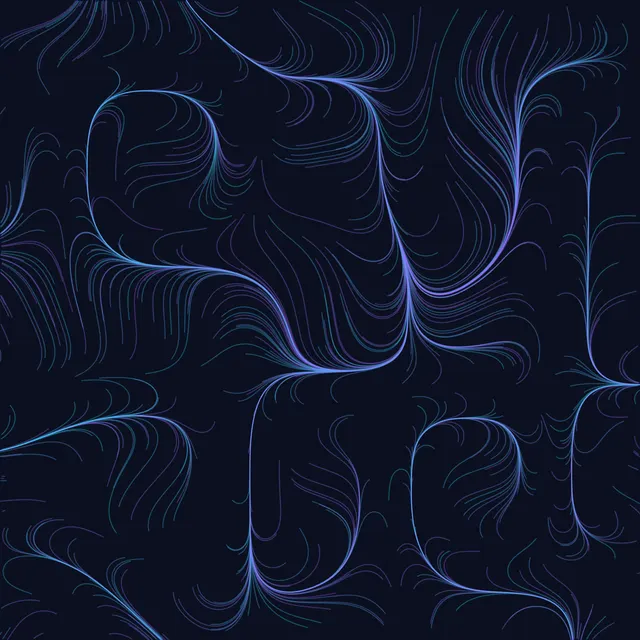
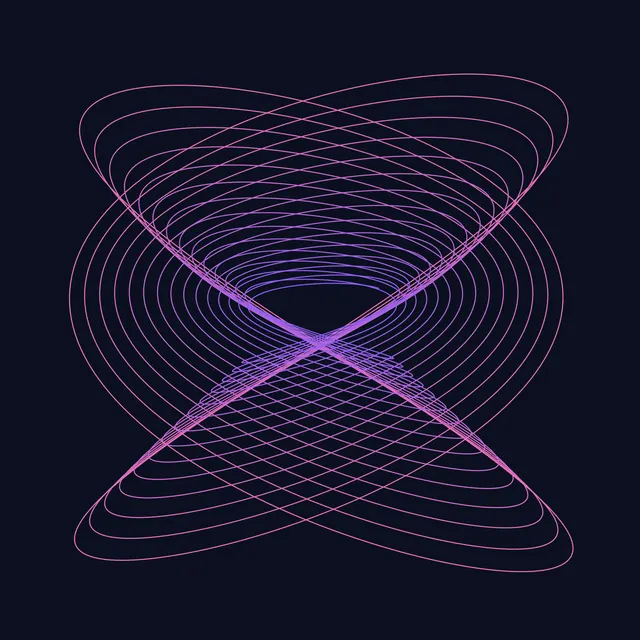
Strange Attractors renders the hidden shapes of chaos. A strange attractor is the set of states a chaotic system keeps returning to: start almost anywhere, apply the same simple equations over and over, and the trajectory never repeats yet stays confined to an intricate, often fractal shape. Plot millions of those points as a density map and they show thin ribbons, feathers and shells.
Explore classic two-dimensional maps — the Clifford, de Jong, Svensson and Bedhead attractors, each a pair of short sine and cosine formulas with four parameters — and three-dimensional flows such as the Lorenz butterfly (the system that gave chaos theory the 'butterfly effect'), the Aizawa attractor and Thomas' cyclically symmetric attractor, which you can rotate in space.
The renderer accumulates points progressively and maps density with a logarithmic tone curve and a color map, so faint filaments and bright cores both stay visible. Press Find interesting to search random parameters for chaotic, well-spread attractors, then export a 4K PNG for prints and wallpapers.
How to use Strange Attractors
- Pick an attractor. Choose a type such as Clifford, de Jong or Lorenz. The image builds up progressively as more points are plotted.
- Tune the parameters. Drag the a, b, c and d sliders. Small changes can transform the shape completely — that sensitivity is the signature of chaos.
- Drag the picture. Drag across a 2D attractor to morph parameters a and b at once, or drag a 3D flow such as Lorenz to turn it in space. The points build up again as soon as you pause.
- Find something new. Press Find interesting to search for random parameters that produce a chaotic, well-spread attractor.
- Rotate 3D flows. For Lorenz, Aizawa and Thomas, use Yaw and Pitch to rotate the attractor before projecting it onto the screen.
- Style and export. Choose a color map, adjust Exposure, and export a PNG up to 4096 px. Share copies a link to the exact parameters.
Frequently asked questions
What is a strange attractor?
A strange attractor is the long-term shape traced by a chaotic dynamical system. Trajectories on it never repeat and are extremely sensitive to initial conditions, yet they stay on a bounded, typically fractal set.
What are the Clifford and de Jong attractors?
They are two-dimensional iterated maps made of sines and cosines with four parameters (a, b, c, d), popularized by Clifford Pickover and Peter de Jong. Each new point is computed from the previous one, and plotting millions of points reveals the attractor.
What is the Lorenz attractor?
The Lorenz system is a simplified model of atmospheric convection studied by Edward Lorenz in 1963. Its butterfly-shaped attractor became the emblem of chaos theory and the 'butterfly effect'.
How do I get a high-resolution print?
Open Export and choose 4096px. The attractor is re-rendered at that resolution with many more points, so filaments stay smooth for large prints and wallpapers.