
Forest Fire & Regrowth
The Drossel-Schwabl forest-fire model: trees regrow, lightning strikes, fires follow a power law.
- Tree
- Burning
- Just burnt
- Bare ground
- Firebreak
- Water
- Rock
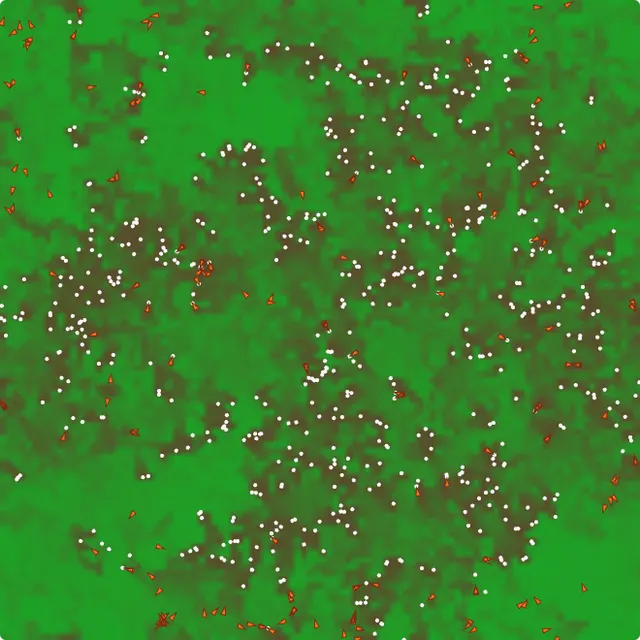
Drag with Ignite to light fires, an event in time; Firebreak, Water, Rock, Plant and Bare ground paint the land, which Rerun keeps. Trees grow back, lightning strikes at random and most fires stay tiny while a few sweep huge areas.
How is Forest Fire & Regrowth working for you?
About Forest Fire & Regrowth
Forest Fire & Regrowth is a live version of the Drossel-Schwabl forest-fire model, a famous example of self-organized criticality published by Barbara Drossel and Franz Schwabl in 1992. The canvas is a grid of cells. Bare ground sprouts a tree with a small probability each step, lightning occasionally sets a tree on fire, and every burning tree ignites its neighbors before burning out to ash.
Those three rules are enough to drive the forest into a critical state. Trees slowly fill the land until clusters of forest connect; then a single lightning strike can sweep through a whole cluster. Most fires burn only a handful of trees, but a few burn enormous areas, and the histogram of fire sizes falls on a nearly straight line on log-log axes — a power law, the same statistical fingerprint seen in real wildfire records, earthquakes and avalanches.
Add wind to make fires race downwind in long tongues, switch on diagonal spread, or change the growth and lightning rates to see how the balance between them changes the size of fires. Paint firebreaks, lakes and rock to protect parts of the forest, light fires yourself, and watch the forest-cover chart rise and fall as the landscape burns and regrows.
How to use Forest Fire & Regrowth
- Let it run. Press Play and give the forest a minute: trees regrow, lightning strikes and fires of every size appear. Raise Speed to reach the steady state faster.
- Read the charts. Forest cover shows the share of land covered by trees over time. Fire sizes plots how many fires burned each number of trees on log-log axes; the dashed line and slope show the power-law fit.
- Check the balance. In the steady state the trees that grow each step equal the trees that burn, so the mean fire size is p(1 − ρ)/(fρ), with p the growth chance, f the lightning chance and ρ the share of land under trees (Drossel and Schwabl 1992). The readout shows the measured mean fire size beside that balance, and the run log records the forest cover and mean fire size of each run at step 2,000.
- Tune growth and lightning. Growth (per thousand cells per step) sets how fast trees return; Lightning (per million cells per step) sets how often fires start. Many small fires appear when lightning is common; rarer lightning lets fuel build up for huge fires.
- Add wind. Set Wind strength and choose which way it blows. Fires spread faster downwind and struggle to move upwind.
- Paint the landscape. Use Ignite to light fires, Firebreak, Water and Rock to stop them, Plant to add trees and Bare ground to remove them. Rerun grows the same forest again from t = 0 with your painted landscape (fires you lit are not repeated); Restart clears the paint and starts the forest again; Reset also returns every setting to its default.
- Export. Save a crisp pixel PNG or record a video or GIF of the fires. Record 30 s from the start runs the same setup again from the beginning and records its first 30 seconds, frame by frame. The CSV files hold the forest cover over time and the run log.
Frequently asked questions
What is self-organized criticality?
It is the tendency of some systems to drive themselves to a 'tipping point' without anyone tuning them. Per Bak, Chao Tang and Kurt Wiesenfeld introduced the idea in 1987 with the sandpile model. At the critical point, events of all sizes occur and their sizes follow a power law. The forest-fire model reaches this state through the slow growth of trees and the rare, fast release of fires.
Why do fire sizes follow a power law?
Between fires, trees grow at random and join into clusters of every size. Lightning hits a random tree, and the fire burns exactly the cluster containing it. Because clusters exist on all scales — from single trees to forests spanning the map — fire sizes do too, with small fires common and large ones rare in a fixed ratio.
Does this model real wildfires?
It captures one key statistical pattern: real wildfire size records often follow power laws over several orders of magnitude, as in Malamud, Morein and Turcotte's 1998 analysis of US and Australian fires. Real fires also depend on weather, terrain, fuel and firefighting, which this simple model ignores.
What do firebreaks do?
A firebreak is a strip with no fuel, so fire cannot cross it. Painting firebreaks splits the forest into smaller connected patches, which caps how large a single fire can grow — a principle used in real forest management.
References
- Drossel, B., & Schwabl, F. (1992). Self-organized critical forest-fire model. Physical Review Letters 69(11), 1629–1632.