
Penguin Huddle
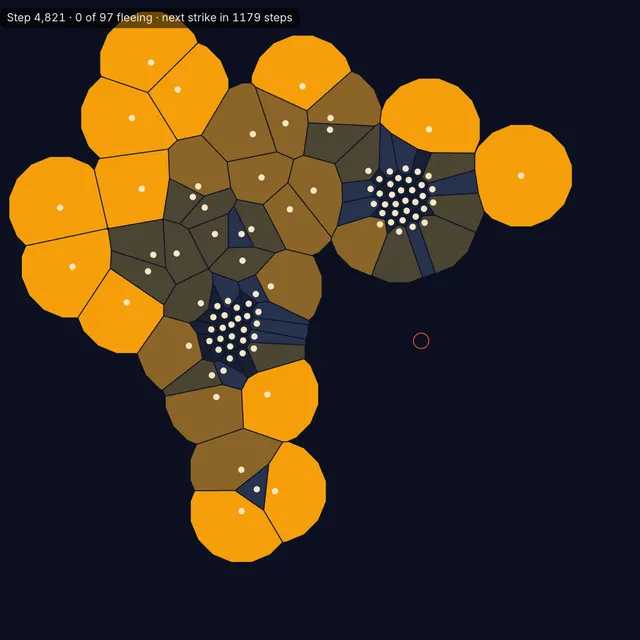
Exposed penguins walk round to the sheltered side, so the huddle creeps downwind and the warmth is shared.
- Walking penguin
- Followed penguin
- Wind
Each move, the penguin losing the most heat walks round the edge of the huddle to the most sheltered spot, so the huddle creeps downwind. Drag across the canvas to turn the wind, and tap a penguin to follow it; Restart starts the same huddle again.
How is Penguin Huddle working for you?


About Penguin Huddle
- Model
- Each penguin lowers its own heat loss (Waters, Blanchette and Kim 2012)
- Huddle
- 30–400 penguins on a hexagonal lattice
- Drift
- About 67 penguin widths per 1,000 moves in a steady wind
- Time on the edge
- 22–37% for the middle 80% of penguins, with wind
- In the field
- Above 0 °C in the huddle at −17 °C outside (Gilbert et al. 2006)
Penguin Huddle simulates how a huddle of emperor penguins shares its warmth. Through the Antarctic winter the males incubate their eggs while fasting, and huddling is how they save energy: Gilbert and colleagues logged huddles that raised the temperature the birds met above 0 °C when it was −17 °C outside, and up to 37.5 °C, and found that all birds had equal access to the warmth. The model asks how that sharing can come about when each penguin looks after only itself.
It follows the 2012 model of Waters, Blanchette and Kim. Penguins stand on a hexagonal lattice; a penguin loses heat through each empty neighboring site, more through those facing the wind. Each move, the boundary penguin that loses the most walks round the edge of the huddle to the empty site where it would lose the least. Penguins inside neither move nor lose much. In the Steady wind preset the huddle creeps downwind about 67 penguin widths every 1,000 moves, and every penguin takes turns at the edge: the middle 80% spend 22% to 37% of their time there.
In calm air no site is better than another, and only Uncertainty moves penguins round the rim, so those inside stay inside: the model needs wind to share the warmth. Real huddles also reorganize from within: Zitterbart and colleagues filmed small steps every 30 to 60 seconds that travel through the huddle as a wave, which this model leaves out. The readout gives the moves, the drift, the penguins on the edge now and the spread of time on the edge; the chart follows that spread.
How to use Penguin Huddle
- Pick a preset. Steady wind blows from the west at Wind 1, Strong wind at Wind 3, and Calm has no wind. Each preset starts a new run with the penguins in a round huddle.
- Watch the huddle. Penguins are colored by the heat they lose, amber when sheltered and sky blue when exposed. The penguin walking round the edge is sky blue; the gray streaks show where the wind comes from.
- Turn the wind. Drag across the canvas in the direction the wind should blow, or set Wind direction; Wind sets how much more a windward side costs. The huddle starts creeping the new way.
- Follow a penguin. Tap a penguin to ring it in white and draw its trail; it sits in the warm middle for a while, then reaches the edge and walks round.
- Read the result. The readout gives the moves, the drift downwind per 1,000 moves, the penguins on the edge now and the share of time on the edge from the 10th to the 90th percentile; the chart follows those two percentiles.
- Start again or export. Restart starts again from the round huddle; Reset also returns every setting to its default. The chart draws the equal share, the time on the edge each penguin would have if it were shared evenly, between the 10th and 90th percentiles, and the run log records the drift and that range after 20,000 moves. Save a PNG, record 8 seconds, or record 30 s from the start.
Frequently asked questions
How do emperor penguins keep warm?
By huddling. Gilbert and colleagues (2006) logged the temperature next to eight emperor penguins: huddles raised it above 0 °C at an average −17 °C outside, above 20 °C for 13% of the huddling time and up to 37.5 °C, and males huddled 38% of their time.
Do penguins take turns on the outside of a huddle?
In effect, yes. Gilbert and colleagues (2006) found that all birds had equal access to the warmth, and Waters, Blanchette and Kim (2012) showed that penguins each lowering their own heat loss is enough to share it. In this simulation, with wind, every penguin spends at least 18% of its time on the edge.
Why does a penguin huddle drift downwind?
Because the penguins on the windward edge, who lose the most heat, walk round to the sheltered side, so the huddle creeps downwind (Waters, Blanchette and Kim 2012). Here it drifts about 67 penguin widths every 1,000 moves in the Steady wind preset.
How do penguins move inside a tightly packed huddle?
In small coordinated steps. Zitterbart and colleagues (2011) filmed every penguin in a huddle taking a small step every 30 to 60 seconds, steps that travel through the huddle as a wave and slowly reorganize it. This simulation does not model those waves; it moves one penguin at a time round the edge.
Is this a scientific model?
It is a teaching model of the rule in Waters, Blanchette and Kim (2012) on a hexagonal lattice. Its numbers are model settings, not measurements: a heat loss of 1 for each empty neighboring site plus Wind for one facing the wind, one move at a time, and a lattice of 56 by 64 sites that wraps at the edges.
References
- Gilbert, C., Robertson, G., Le Maho, Y., Naito, Y., & Ancel, A. (2006). Huddling behavior in emperor penguins: dynamics of huddling. Physiology & Behavior 88, 479–488.
- Zitterbart, D. P., Wienecke, B., Butler, J. P., & Fabry, B. (2011). Coordinated movements prevent jamming in an emperor penguin huddle. PLoS ONE 6(6), e20260.
- Waters, A., Blanchette, F., & Kim, A. D. (2012). Modeling huddling penguins. PLoS ONE 7(11), e50277.