
Wolf Pack Territories
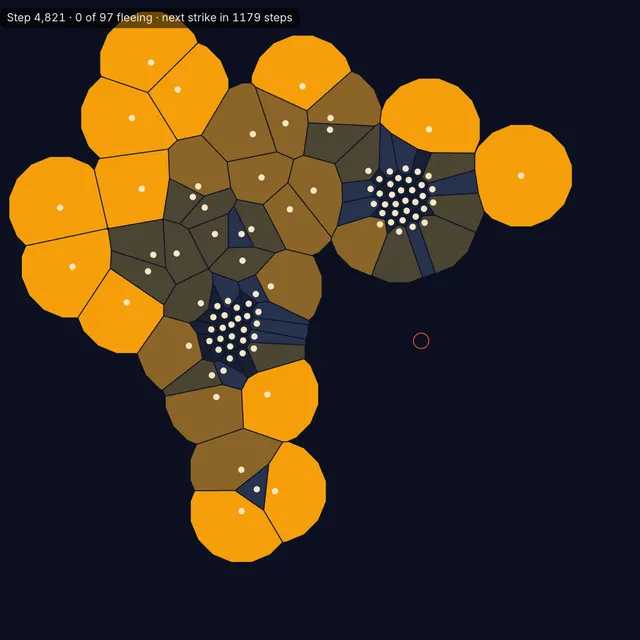
Wolf packs divide the land by scent marks, with buffer zones between territories where deer survive.
- Pack 1
- Pack 2
- Pack 3
- Pack 4
- Pack 5
- Pack 6
- Den
- Territory, tinted by pack
- Buffer zone or unclaimed
- Deer
- Lake
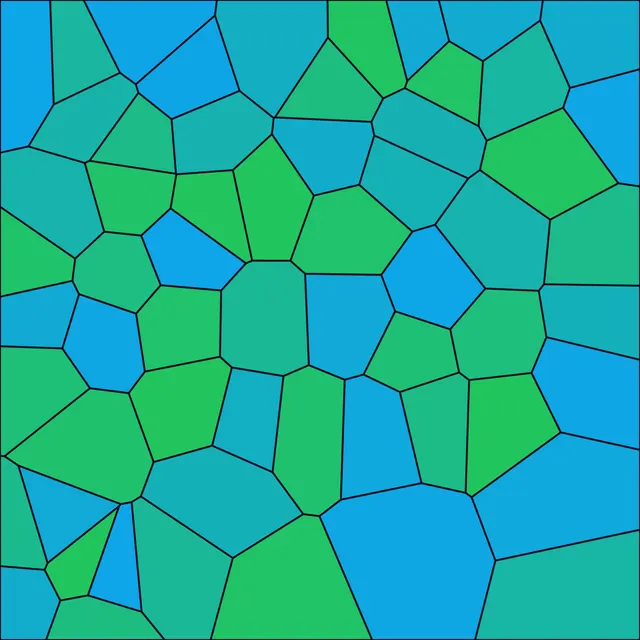
Each pack ranges from its den and marks it with scent; where wolves smell a neighbor's marks ahead they mark more and turn back, so territories tile the land with buffer zones between them. Tap to place a den or remove a pack, paint lakes and Erase them, or drop deer, an event in time, and see where they last. Rerun keeps the dens and lakes.
How is Wolf Pack Territories working for you?

About Wolf Pack Territories
- Model
- Scent marking with retreat from foreign marks (Lewis and Murray 1993)
- Packs
- Up to 8, with 2–10 wolves each
- Territories
- About 83% of the land after 6,000 steps with six packs
- Buffer zones
- Unclaimed land within about 37 units of two territories
- Deer
- Up to 1,500; they last longest in buffer zones (Mech 1977)
Wolf Pack Territories simulates how packs of wolves divide the land with scent marks. Each pack has a den; its wolves wander from it in a correlated random walk, turn back toward it more the farther they go, and leave their pack's scent where they walk. A wolf that smells another pack's marks 30 units ahead marks more and turns back toward its den. Marks fade but do not spread. This is the mechanism Mark Lewis and James Murray modeled in 1993, after field studies in northeastern Minnesota found buffer zones where wolves are scarce between neighboring packs and more scent marking near them.
A cell belongs to the pack whose scent is strongest there, once that scent passes a set level; unclaimed land within about 37 units of two territories is a buffer zone. With six packs, territories cover about 83% of the field after 6,000 steps, and buffer zones, about 10% of it, lie between them. How long marks last sets how much land a pack can hold, as Luca Giuggioli, Jonathan Potts and Stephen Harris showed for scent-marking animals in 2011: raise Scent fades and the territories shrink.
Deer walk at random, breed toward a ceiling of 1,500 and are caught by wolves within 8 units. Wolves seldom enter the buffer zones, so deer last longest there: in L. David Mech's 1977 study, the surviving deer of a declining herd lived where pack territories met, where wolves hunted little to avoid fatal encounters with their neighbors. The readout gives each pack's share of the land and the share of the land and of the deer in buffer zones; the chart follows both. Remove a pack and its neighbors take over its land as its scent fades.
How to use Wolf Pack Territories
- Pick a preset. Six packs places six dens and shows the territories forming. Buffer zones and deer adds 600 deer; Remove a pack adds deer and sets the pointer to Remove pack.
- Watch territories form. Each pack's land takes a flat tint of its color as its scent passes the set level; buffer zones keep the dark ground. Dens are rings, wolves discs in their pack's color, deer cream dots.
- Change the map. With Tool on Den, tap to place a new pack; on Remove pack, tap near a den to take that pack away; on Lake, drag to paint water that wolves walk around; on Deer, drag to drop deer; on Erase, drag to remove water. Rerun starts again from t = 0 with your dens and lakes; Restart clears them and starts the preset again; Reset also returns every setting to its default.
- Tune the packs. Pull to den sets how far wolves range, Marking at borders how much more they mark near a neighbor, Retreat from neighbors how hard they turn back, and Scent fades how long marks last. The ? beside each setting explains it with numbers.
- Read the buffer zones. The readout lists each pack's share of the land in its color, and the share of the land and of the deer in buffer zones. With deer on the map, the chart shows the deer's share rising above the land's.
- Export. Save a PNG, record 8 seconds, or record 30 s from the start, which runs the same setup again from the beginning and records it frame by frame.
Frequently asked questions
How do wolves mark their territory?
With scent marks left along the routes they travel, and more of them near the edges where neighbors' marks lie. Roger Peters and L. David Mech described scent marking by wolves in Minnesota in 1975, and Lewis and Murray's 1993 model shows how such marking, with wolves turning back from foreign marks, can divide the land into territories.
What is a buffer zone between wolf packs?
A strip of land between neighboring territories where wolves spend little time, because entering it risks a fight with the neighbors. Mech (1977) found that the deer that survived a decline in northeastern Minnesota lived in these overlapping edges, where wolves hunted little. In this simulation buffer zones hold about 10% of the land and, with deer on the map, a larger share of the deer.
Why do deer survive in buffer zones?
Because wolves hunt least there. Wolves that meet neighbors risk being killed, so they avoid the edges of their territories; deer along those edges face fewer wolves, and Mech (1977) proposed that their young later restock the territory cores. Here, deer caught by wolves within 8 units vanish fastest in the cores.
What happens when a pack disappears?
Its neighbors spread into its land as its scent marks fade. In the Remove a pack preset, tap a den: the pack leaves, its marks fade over about 1,400 steps at the default setting, and the readout shows the neighboring packs' shares growing. Moorcroft, Lewis and Crabtree (2006) predicted such shifts for coyote packs in Yellowstone with the same kind of model.
Is this a scientific model?
It is a teaching model of a published mechanism, scent marking with retreat from foreign marks (Lewis and Murray 1993; White, Lewis and Murray 1996). Its numbers are model settings chosen so territories form within a minute, not measurements of real packs: the field of 1,000 units, the 30 units at which wolves smell, the deer's breeding and the wolves' hunting success.
References
- Peters, R. P., & Mech, L. D. (1975). Scent-marking in wolves. American Scientist 63(6), 628–637.
- Mech, L. D. (1977). Wolf-pack buffer zones as prey reservoirs. Science 198, 320–321.
- Lewis, M. A., & Murray, J. D. (1993). Modelling territoriality and wolf–deer interactions. Nature 366, 738–740.
- Mech, L. D. (1994). Buffer zones of territories of gray wolves as regions of intraspecific strife. Journal of Mammalogy 75(1), 199–202.
- White, K. A. J., Lewis, M. A., & Murray, J. D. (1996). A model for wolf-pack territory formation and maintenance. Journal of Theoretical Biology 178(1), 29–43.
- Moorcroft, P. R., Lewis, M. A., & Crabtree, R. L. (2006). Mechanistic home range models capture spatial patterns and dynamics of coyote territories in Yellowstone. Proceedings of the Royal Society B 273, 1651–1659.
- Giuggioli, L., Potts, J. R., & Harris, S. (2011). Animal interactions and the emergence of territoriality. PLoS Computational Biology 7(3), e1002008.
- Potts, J. R., & Lewis, M. A. (2014). How do animal territories form and change? Lessons from 20 years of mechanistic modelling. Proceedings of the Royal Society B 281, 20140231.