
Rumor Spread
Pass a story from person to person on a network and see how many hear it before the spreaders stop.
- Unaware
- Spreading
- Done
- Knew first
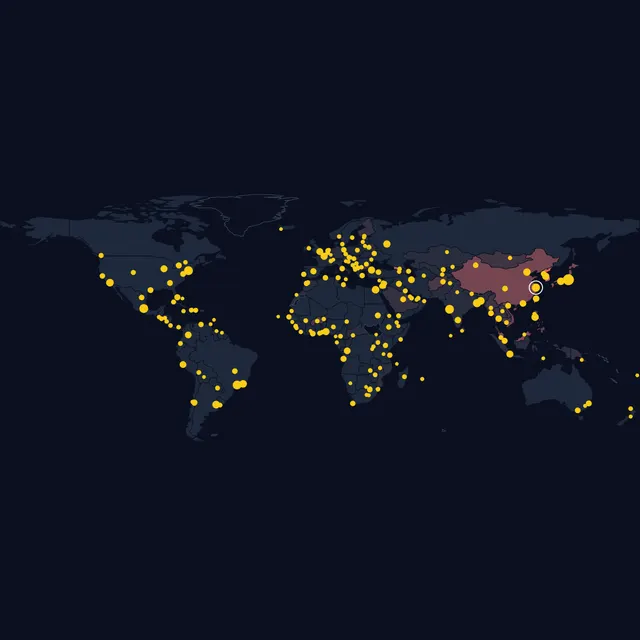
Spreaders tell one random contact per round on average; a spreader who meets someone who already knows stops. Tap a person to tell them the story now, or a ringed person to take them out of those who know first; Rerun starts again from the ringed people.
How is Rumor Spread working for you?


About Rumor Spread
- Model
- Maki-Thompson rumor model
- Never hear, everyone meets everyone
- 20.3% (Nekovee et al. 2007)
- Networks
- Small world, hubs, groups
- Round
- One contact per spreader on average
Rumor Spread passes a story from person to person with the Maki-Thompson rumor model, as Maziar Nekovee, Yamir Moreno, Ginestra Bianconi and Matteo Marsili stated it in 2007. Each person is unaware, spreading or done. A spreader tells one random contact per round on average: an unaware person who hears the story starts spreading it with the Passing chance, and a spreader who meets someone who already knows stops with the Stopping chance. Spreaders can also forget the story and stop on their own.
Unlike a disease, a story stops without anyone recovering: spreaders give up when the people they meet already know it. When everyone can meet everyone, the share who ever hear the story, R, solves R = 1 − e^(−εR) with ε = (α + λ)/(δ + α), from the Passing chance λ, the Stopping chance α and the Forgetting rate δ (Nekovee et al. 2007). With every contact passing the story and every meeting stopping the teller, about 20.3% never hear it, and the chart draws that share.
Networks change the answer. A small world is a ring of neighbors with a few links moved at random (Watts and Strogatz 1998), hubs grow by newcomers linking to people who already have many links (Barabási and Albert 1999), and groups are joined by a few weak ties, after Mark Granovetter (1973). Tap a person to make them know first, compare runs in the Runs table, and export a PNG, video, GIF or CSV.
How to use Rumor Spread
- Pick a story. Choose Everyone meets everyone, Small world, Hubs, Groups and weak ties, Forgetting, Fading interest or Both stop (Daley-Kendall). Each preset sets every control.
- Shape the network. Set the Network and People from 50 to 600; for a network, set Contacts from 4 to 16 per person, the Rewiring of a small world and the Weak ties between groups.
- Set the rules. Rule picks who stops when two spreaders meet. Passing chance, Stopping chance and Forgetting set how the story moves, and Interest half-life halves the Passing chance every few rounds.
- Choose who knows first. Tap a person to add them to the people who know first: anyone who has not heard yet starts spreading the story at once. Tap a ringed person to take them out; before the first round they forget it again, and later the story already told stays. Rerun starts again from the ringed people, Restart lets the seed choose, and Reset returns every setting to its default.
- Read the result. The readout counts the unaware, spreading and done people and the share who heard. The chart plots the three shares over rounds and, when everyone meets everyone under the Maki-Thompson rule, the exact share who never hear.
- Export. Save a PNG, record 8 seconds, or record the full run until nobody is spreading. The CSV files hold the three shares every quarter round and the Runs table, and a share link carries who knew first.
Frequently asked questions
How many people never hear a story?
When everyone can meet everyone, every contact passes the story and every meeting with someone who knows stops the teller, about 20.3% never hear it. The share who hear it, R, solves R = 1 − e^(−2R) in the model of Nekovee and colleagues (2007), and the tool's runs come out within a percent of it.
Why does a story stop spreading?
Because spreaders meet people who already know it. In the Daley-Kendall and Maki-Thompson models that is the only way a story stops; Nekovee and colleagues (2007) added forgetting, and with it a story takes hold only if the Passing chance is larger than the Forgetting rate, here with one contact per round.
Do some stories travel farther than others?
Yes. Soroush Vosoughi, Deb Roy and Sinan Aral (2018) followed about 126,000 news stories shared by about 3 million people more than 4.5 million times and found that false stories spread farther, faster, deeper and more broadly than true ones, and were more novel. Here a story's appeal is its Passing chance and its fading is the Interest half-life, both model settings.
Is a round an hour or a day?
Neither: a round is the time in which each spreader makes one contact on average. The rules and the exact share come from the papers cited; the network sizes, the contacts per person and the half-life are model settings.
References
- Nekovee, M., Moreno, Y., Bianconi, G., & Marsili, M. (2007). Theory of rumour spreading in complex social networks. Physica A 374(1), 457–470.
- Daley, D. J., & Kendall, D. G. (1964). Epidemics and rumours. Nature 204, 1118.
- Watts, D. J., & Strogatz, S. H. (1998). Collective dynamics of 'small-world' networks. Nature 393, 440–442.
- Barabási, A.-L., & Albert, R. (1999). Emergence of scaling in random networks. Science 286, 509–512.
- Granovetter, M. S. (1973). The strength of weak ties. American Journal of Sociology 78(6), 1360–1380.
- Wu, F., & Huberman, B. A. (2007). Novelty and collective attention. PNAS 104(45), 17599–17601.
- Vosoughi, S., Roy, D., & Aral, S. (2018). The spread of true and false news online. Science 359, 1146–1151.