
Termite Mound Building
Termites drop soil where pheromone from fresh soil is strong, so evenly spaced pillars rise with no plan.
- Carrying soil
- Fetching soil
Termites carrying soil walk toward the stronger cement pheromone and drop their pellets where it is strong; fresh soil gives off more, so heaps grow into pillars. Paint soil to start a heap, place the queen to raise a wall round her, or erase; Rerun starts again from step 0 with the soil you painted and the queen.
How is Termite Mound Building working for you?

About Termite Mound Building
- Model
- Pillar building by cement pheromone (Deneubourg 1977; Bonabeau et al. 1998)
- Termites
- 100–1,000 on a field 1,000 units across
- Pillars
- About 14–18 within 4,000 steps at the defaults
- Spacing
- About 140 units at 0.1% evaporation, 220 at 0.5%
- Royal chamber
- About 97% of the soil in the band round the queen
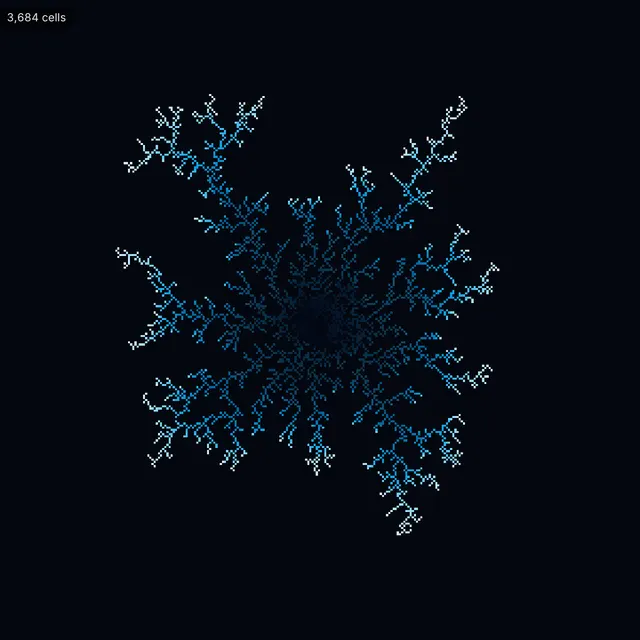
Termite Mound Building simulates how termites raise pillars of soil with no plan and no leader. Each termite carries a pellet of soil, walks toward the stronger cement pheromone ahead of it, and drops the pellet with a chance that rises with the pheromone where it stands; then it walks off to fetch another. Fresh soil gives off pheromone for a while, so a heap draws more soil to itself. Pierre-Paul Grassé named this kind of coordination stigmergy in 1959: the work already done steers the work that follows. Jean-Louis Deneubourg turned it into a model of pillar building in 1977.
Heaps compete for the termites around them. A termite that has just dropped its pellet leaves to fetch soil, and one that comes back laden is drawn to the nearest heap, so the ground between heaps stays bare and pillars rise apart. With 600 termites, about 14 to 18 pillars hold some two thirds of the soil after 4,000 steps. How long the pheromone lasts sets how many there are: at 0.5% evaporation per step the pillars stand about 220 units apart, at 0.1% about 140, with much of the soil spread thin between them.
Eric Bonabeau and colleagues extended the model in 1998 with a queen who gives off a pheromone of her own, which acts as a template. In the Royal chamber preset termites drop soil only where her pheromone lies in a band, 61 to 100 units from her, and about 97% of the soil ends up in a wall round her. Their model also had wind, a stream of termites and trails, which turn pillars into walls and galleries; this tool leaves those out. The chart follows the number of pillars and the share of the soil in them.
How to use Termite Mound Building
- Pick a preset. Pillars starts on bare ground at 0.2% evaporation. Royal chamber puts the queen at the center. Slow evaporation and Fast evaporation run at 0.1% and 0.5% to compare the spacing of the pillars.
- Watch the pillars rise. Cream dots are termites carrying soil and gray dots termites fetching more. Soil darkens to light tan as it piles up; a pillar is a patch holding at least 36 pellets in a cell and its eight neighbors.
- Change the ground. With Tool on Soil, drag to paint heaps that start pillars; on Queen, tap or drag to place her; on Erase, drag to remove soil, or the queen under the brush. Rerun starts again from t = 0 with your soil and queen; Restart returns the preset's ground; Reset also returns every setting to its default.
- Tune the pheromone. Cement pheromone sets how much a pellet gives off, Evaporation how fast it fades and Spread how fast it diffuses; Show pheromone tints the ground where it lies. The ? beside each setting explains it with numbers.
- Read the result. The readout gives the number of pillars, the mean distance from each to its nearest neighbor, the share of the soil in pillars and the pellets dropped; the chart follows the first and the third.
- Export. Save a PNG, record 8 seconds, or record 30 s from the start, which runs the same setup again from the beginning.
Frequently asked questions
How do termites build mounds without a plan?
By responding to what is already built. A termite drops soil where cement pheromone from fresh soil is strong, so heaps draw more soil, a coordination Pierre-Paul Grassé called stigmergy in 1959. In this simulation 600 termites raise about 14 to 18 pillars within 4,000 steps, with no termite knowing where a pillar goes.
What is stigmergy?
Coordination through the work itself: each act changes the surroundings, and the change steers the next act. Grassé coined the term in 1959 for termites rebuilding their nest; the pheromone trails of ants are another example.
Why are termite pillars spaced apart?
Because heaps compete for the termites around them. Laden termites are drawn to the nearest heap's pheromone and leave to fetch soil after dropping, so the ground between heaps stays bare. Here, faster evaporation leaves fewer pillars farther apart: about 220 units at 0.5% per step against 140 at 0.1%.
How do termites build a royal chamber?
Round the queen's own pheromone. Bonabeau and colleagues (1998) modeled a queen whose pheromone acts as a template, and termites that build where it lies in a band raise a wall round her. In the Royal chamber preset about 97% of the soil ends up in that band.
Is this a scientific model?
It is a teaching model of Deneubourg's 1977 pillar model with the queen's template of Bonabeau and colleagues (1998). Its numbers are model settings, not measurements: a field 1,000 units across, termites walking 2 units a step, the chance of dropping a pellet and how long fresh soil gives off pheromone.
References
- Grassé, P.-P. (1959). La reconstruction du nid et les coordinations interindividuelles chez Bellicositermes natalensis et Cubitermes sp. La théorie de la stigmergie. Insectes Sociaux 6, 41–80.
- Deneubourg, J.-L. (1977). Application de l'ordre par fluctuations à la description de certaines étapes de la construction du nid chez les termites. Insectes Sociaux 24, 117–130.
- Bonabeau, E., Theraulaz, G., Deneubourg, J.-L., Franks, N. R., Rafelsberger, O., Joly, J.-L., & Blanco, S. (1998). A model for the emergence of pillars, walls and royal chambers in termite nests. Philosophical Transactions of the Royal Society B 353, 1561–1576.
- Camazine, S., Deneubourg, J.-L., Franks, N. R., Sneyd, J., Theraulaz, G., & Bonabeau, E. (2001). Self-Organization in Biological Systems. Princeton University Press.