
Oscillating Reaction
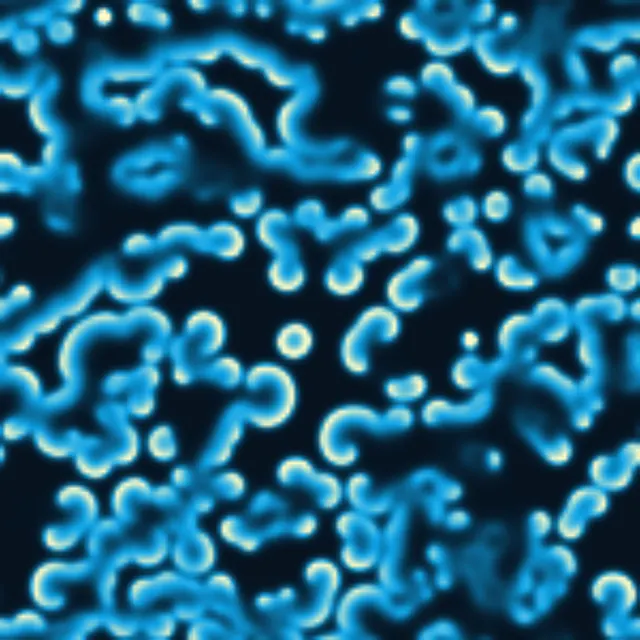
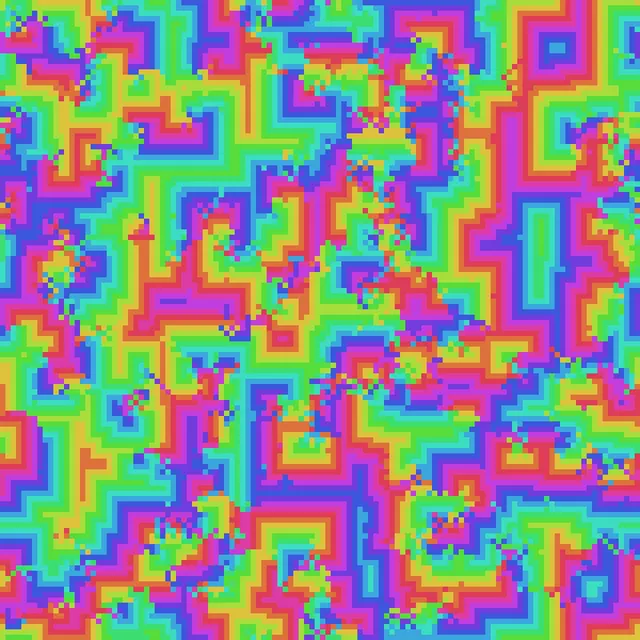
The Belousov-Zhabotinsky reaction on your GPU — chemical waves curl into rotating spirals.
Three chemicals chase each other in a rock-paper-scissors cycle, winding into rotating spirals. Drag to stir the dish and break waves into new spirals; Calm smooths a patch back to rest.
How is Oscillating Reaction working for you?

About Oscillating Reaction
Oscillating Reaction simulates the Belousov-Zhabotinsky (BZ) reaction, the chemical clock that changes color back and forth by itself. Boris Belousov discovered it in the 1950s, but journals rejected his result as impossible; Anatol Zhabotinsky later confirmed and explained it. Spread thin in a dish, the reaction doesn't just pulse — it sends out rings and rotating spiral waves, a standard example of pattern formation in chemistry.
The simulation uses Alasdair Turner's simple three-chemical model. Every cell of the dish holds amounts of three substances, a, b and c. Each step a cell mixes with its neighbors (diffusion), then the chemicals feed on each other in a cycle — a consumes b, b consumes c and c consumes a — like rock, paper, scissors. Waves of each chemical chase the one it eats, and wherever a wave front breaks, its free end curls up into a spiral. It all runs on your GPU, with each chemical in one color channel of a floating-point texture.
Start from random chaos, a single giant spiral, target waves sent out by pacemaker spots, or a calm dish you disturb yourself. Tune the reaction rates α, β and γ, stir the dish with the brush to break waves into new spirals, color it with a color map or by mixing the three chemicals, and export a PNG, video or GIF.
How to use Oscillating Reaction
- Pick a start. Spiral chaos starts from random concentrations, Single spiral winds the dish into one big rotating arm, Target waves adds pacemakers that send out rings, and Calm starts at rest so you can paint a disturbance.
- Stir the dish. Drag on the canvas with the Stir brush to add random chemicals and break wave fronts into new pairs of spirals. Calm smooths a patch back to the resting mix.
- Tune the reaction. α, β and γ set how strongly each chemical consumes the next. Equal values give symmetric spirals; unequal values change their speed, thickness and stability.
- Change the dish. Grid sets the resolution (larger grids show more, smaller spirals); Speed sets the reaction steps per second, which the readout counts.
- Color it. Color map shows chemical a through a palette; Three chemicals mixes a custom color for each of a, b and c.
- Export. Save a PNG up to 2048 px or record a video or GIF of the turning spirals.
Frequently asked questions
What is the Belousov-Zhabotinsky reaction?
It is a family of chemical reactions, typically malonic acid oxidized by bromate with a cerium or ferroin catalyst, in which the concentrations of intermediate chemicals oscillate for minutes to hours instead of settling down. In a thin unstirred layer, the oscillations travel as waves, forming rings and spirals.
Why do spirals form?
The medium is excitable: a wave front triggers the next region ahead of it, and the region behind it needs time to recover. If a front is broken, its free end can't advance into the recovering region behind it, so it pivots around the break point and winds into a rotating spiral. The same mechanism produces spiral waves in heart tissue and in colonies of slime mold.
How is this related to rock-paper-scissors?
In Turner's model each chemical grows by consuming the next one in a cycle, just as rock beats scissors, scissors beat paper and paper beats rock. Cyclic dominance plus diffusion is enough to produce the BZ reaction's traveling waves and spirals, and the same idea explains spiral patterns in some bacterial and lizard populations.
Is this an exact chemical model?
No. Turner's model is a simplified, fast model designed to reproduce the reaction's patterns rather than its precise chemistry. Chemists use more detailed models such as the Oregonator, developed by Richard Field and Richard Noyes in 1974.