
Crow Mobbing
Crows that know a dangerous face scold it, naive crows in the mob learn it, and the knowledge spreads for years.
- Naive
- Trapped
- Learned in a mob
- Learned from parents
- Banded
- Dangerous mask
- Neutral mask
- Scolding
- Walk route
- Trapping site
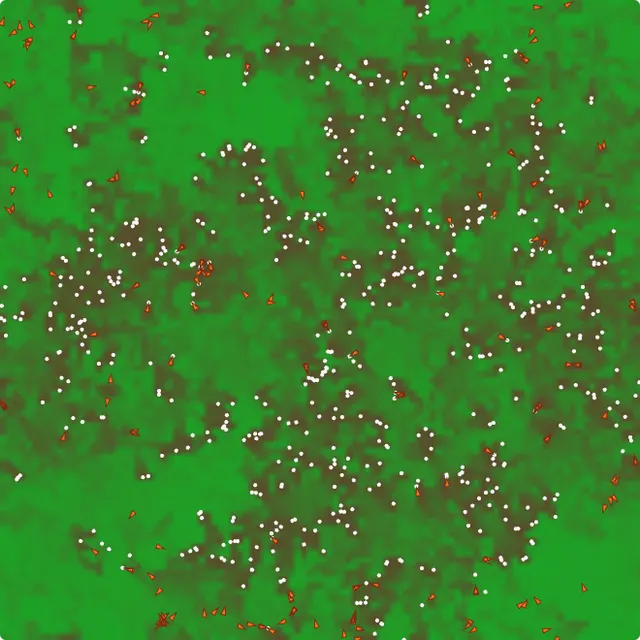
Drag on the park to walk the masked person: crows that know the dangerous face scold it and draw a mob, and naive crows in the mob can learn the face. Tap a crow to trap and band it; Rerun traps those crows again at year 0.
How is Crow Mobbing working for you?




About Crow Mobbing
- Model
- Social learning of a dangerous face (Cornell, Marzluff and Pecoraro 2012)
- Park
- 2 km across, 50–400 crows
- Year
- 3,000 steps; 15% of crows die and fledglings take their places
- Field result
- Scolding doubled and spread at least 1.2 km in five years at one site
- Memory
- At least 2.7 years (Marzluff et al. 2010)
Crow Mobbing simulates how knowledge of a dangerous face spreads through the crows of a park. Heather Cornell, John Marzluff and Shannon Pecoraro trapped, banded and released 7 to 15 American crows at each of five sites near Seattle while wearing a unique mask, then showed the crows that mask and a neutral one. Crows that had been caught scolded the dangerous mask; so, later, did crows that were never caught, and young crows whose parents scolded it. At one site scolding doubled in frequency and spread at least 1.2 km from the trapping site in five years.
The model follows that design. A park 2 km across holds 50 to 400 crows, each flying about its own home. At the start the person traps the 10 crows living nearest the square and stays there 300 steps; then the person walks a loop of about 2.9 km twice a year. A crow that knows the dangerous mask and sees it within 120 m scolds and flies at it; crows within 300 m of a scolding crow join the mob, and a naive crow in the mob that sees the mask learns it with the chance Learning in a mob. A crow more than 360 m from home stops and flies back, so a walk meets one local mob after another. Mobbing as a way to pass on enemy recognition was shown by Eberhard Curio and colleagues in blackbirds in 1978.
Each year of 3,000 steps, 15% of the crows die and fledglings of surviving crows settle within 160 m of their parents' homes; a fledgling of a crow that knows the face knows it with the chance Learning from parents. Nobody reacts to the neutral mask. The chart stacks the share of crows that scold the dangerous mask by how they learned it, and the readout compares the share with the share after year 1 and gives the distance from the trapping site to the home of the farthest crow that knows. At the default settings the share roughly doubles between year 1 and year 5, and the farthest crow that knows lives about 1.3 to 1.5 km from the site.
How to use Crow Mobbing
- Pick a preset. Trapping, then walks traps 10 crows at the square and walks the dangerous mask around the loop twice a year. Neutral mask walks the neutral mask instead; No social learning sets both learning chances to 0. Each preset starts a new run.
- Watch the trapping. The person, a white disc with a red mask, stands at the square for 300 steps. Trapped crows, red with a white ring for the band, scold; crows within 300 m hear them and join the mob, and some learn the face and turn amber.
- Walk the person. Drag on the park to walk the masked person yourself; lines join each scolding crow to the person. Tap a crow to trap and band it: the person stays there for 300 steps with the dangerous mask, and a mob gathers.
- Change the learning. Learning in a mob sets the chance that a naive crow in a mob learns the face, and Learning from parents the chance that a fledgling of a crow that knows learns it. Walks per year sets how often the masked person walks the loop; Mask switches the face. The ? beside each setting explains it.
- Read the years. The readout gives the year, the share of crows that scold the dangerous mask by how they learned it, that share against the share after year 1, the distance to the farthest crow that knows, and the crows still banded.
- Start again or export. Rerun starts again from t = 0 with the crows you trapped; Restart drops them and starts the preset again; Reset also returns every setting to its default. Save a PNG, record 8 seconds, or record the full run of five years from the start.
Frequently asked questions
Do crows remember faces?
Yes. Wild American crows trapped by a person in a mask learned to recognize that face quickly and accurately and still scolded it at least 2.7 years later (Marzluff et al. 2010). Crows that were never trapped learned the face from other crows (Cornell, Marzluff and Pecoraro 2012).
How do crows learn who is dangerous?
From their own experience and from other crows. Cornell, Marzluff and Pecoraro (2012) trapped 7 to 15 crows at each of five sites near Seattle while wearing a mask; crows that were never caught later scolded the mask, which is horizontal social learning, and young crows learned it from their parents, which is vertical social learning.
What is mobbing?
Birds gathering around a predator and calling at it, which draws more birds. Curio, Ernst and Vieth (1978) showed in blackbirds that seeing another bird mob teaches a bird to mob the same enemy, and that recognition passed along a chain of at least six birds. Crows also mob around their dead and learn to fear people seen there (Swift and Marzluff 2015).
How far does knowledge of a face spread?
At least 1.2 km in five years: in Cornell et al. (2012), scolding at one site doubled in frequency and spread that far from the trapping site. In this simulation at the default settings, the share of crows that scold roughly doubles between year 1 and year 5, and the farthest crow that knows lives about 1.3 to 1.5 km from the site.
Why does nobody react to the neutral mask?
Because no crow was trapped by a person wearing it, so no crow links that face to danger; it is the control. In the field, crows that learned from others told the dangerous and neutral masks apart less precisely than crows that had been trapped (Cornell et al. 2012). The model leaves that out.
Is this a scientific model?
It is a teaching model of the mechanism Cornell, Marzluff and Pecoraro (2012) describe. Its numbers are model settings, not measurements: 3,000 steps a year, 15% of crows dying each year, crows seeing the person within 120 m, hearing scolding within 300 m and mobbing no farther than 360 m from home.
References
- Curio, E., Ernst, U., & Vieth, W. (1978). Cultural transmission of enemy recognition: one function of mobbing. Science 202, 899–901.
- Marzluff, J. M., Walls, J., Cornell, H. N., Withey, J. C., & Craig, D. P. (2010). Lasting recognition of threatening people by wild American crows. Animal Behaviour 79(3), 699–707.
- Cornell, H. N., Marzluff, J. M., & Pecoraro, S. (2012). Social learning spreads knowledge about dangerous humans among American crows. Proceedings of the Royal Society B 279, 499–508.
- Swift, K. N., & Marzluff, J. M. (2015). Wild American crows gather around their dead to learn about danger. Animal Behaviour 109, 187–197.