
Radioactive Decay
Watch atoms decay one at a time and the sample halve every half-life, with Geiger counts that follow a Poisson law.
To count decays at a steady rate and compare them with the Poisson distribution, pick Geiger counting or set Each step to 1/24,000 of a half-life.
Every atom has the same small chance of decaying in each moment, however long it has waited, so the sample shrinks by half every half-life. Tap to add 60 fresh atoms there, an event in time that Restart and share links leave out, and turn on Geiger clicks to hear the decays.
How is Radioactive Decay working for you?

About Radioactive Decay
- Decay law
- N(t) = N₀ × (1/2)^(t / T½)
- Described
- Rutherford and Soddy, 1902
- Counting statistics
- Poisson: variance equals the mean (1910)
- Carbon-14 half-life
- 5,730 years
Radioactive Decay shows a sample of unstable atoms turning into other elements one at a time. Every atom has exactly the same small chance of decaying in each moment, however long it has already waited, so no one can say when a given atom will go, yet the sample as a whole shrinks at a predictable rate: half of it is gone after one half-life, three quarters after two, seven eighths after three. Ernest Rutherford and Frederick Soddy described this law in 1902, when they showed that radioactivity is one element transforming into another. Watch the atoms change color as they decay, compare the count left with the exponential curve the chance predicts, and tap to add fresh atoms.
Because decays are random and independent, the number counted in equal intervals of time varies in a particular way: it follows a Poisson distribution, whose variance equals its mean. In 1910 Rutherford and Hans Geiger counted the alpha particles from a radioactive source in thousands of equal intervals a few seconds long, and Harry Bateman showed that their counts fit the Poisson law, the same law Ladislaus Bortkiewicz had found for rare events such as deaths from horse kicks in the Prussian army. The Geiger counting preset repeats the experiment with a large, slowly decaying sample, and the histogram fills in against the Poisson curve.
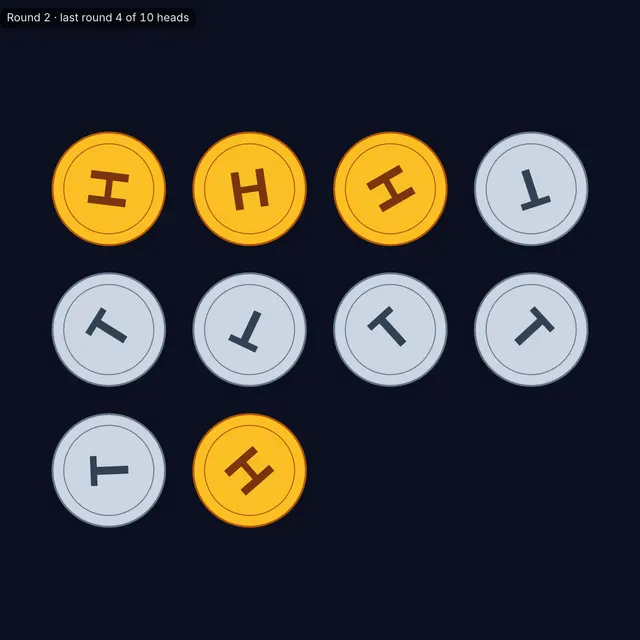
Choose carbon-14 (half-life 5,730 years), iodine-131 (8.02 days), cobalt-60 (5.27 years) or a generic isotope, and try a decay chain: bismuth-210 decays to polonium-210, which decays in turn to stable lead-206, and the daughter atoms build up and fade as Bateman's equations predict. Coin-flip decay turns the classroom experiment of flipping coins and removing the heads into a simulation, and Small sample shows how bumpy the curve gets with only 50 atoms. Turn on Geiger clicks to hear the decays, and export the interval counts as CSV.
How to use Radioactive Decay
- Press Play. Green atoms decay one at a time and turn gray (or orange in a chain). The counter shows the time passed and the share of atoms left against the expected share.
- Pick an isotope. Choose Carbon-14, Iodine-131, Cobalt-60, the Bismuth-210 chain or Any isotope, and set the number of Atoms. The time shows in that isotope's own units.
- Read the charts. Atoms compares the count left with the expected curve. Decays per interval counts how many atoms decay in equal stretches of time and compares the counts with a Poisson distribution.
- Try a chain. With Any isotope, turn on Decay chain and set the Daughter half-life as a multiple of the parent's, or pick the Bismuth-210 chain.
- Change the time. Each step sets how much time one step covers: a 240th of a half-life for smooth curves, a 24,000th for steady Geiger counts, or a whole half-life for coin-flip rounds. Speed sets how many steps run each second and shows how much of the isotope's time that is: 20 steps of a 240th of a half-life each second is about 478 years per second for carbon-14.
- Add atoms and listen. Tap the sample to add a clump of 60 fresh atoms, an event in time that Restart and share links leave out, and turn on Geiger clicks to hear each decay.
- Export. Save a PNG, a video or GIF, or the interval counts with their Poisson expectations as a CSV file. Record full run plays the sample again from the start until every atom has decayed; for Geiger counting, where that would take far too long, Record 30 s from the start records the first 30 seconds.
Frequently asked questions
What is a half-life?
The time it takes for half of the atoms in a sample to decay. It is the same however much is left: after one half-life half remains, after two a quarter, after three an eighth. Carbon-14's half-life is 5,730 years, iodine-131's is about 8 days, and some isotopes last billions of years or less than a second.
Can you predict when one atom will decay?
No. Decay is random: each atom has the same chance of decaying in the next moment whatever its age, so an atom that has survived for a long time is no closer to decaying than a fresh one. Only the behavior of many atoms together is predictable, which is why the curve is smooth for a big sample and bumpy for a small one.
Why does the number left follow an exponential curve?
Because in each moment the same fraction of the atoms still present decays. A quantity that shrinks by a constant percentage per unit of time decays exponentially: N(t) = N₀ × (1/2)^(t / T½), where T½ is the half-life.
What is the Poisson distribution?
It describes how many rare, independent events happen in a fixed interval when they occur at a steady average rate. Its mean and its variance are equal. Rutherford, Geiger and Bateman showed in 1910 that alpha particle counts follow it, and Bortkiewicz had found the same pattern in 1898 for rare accidents.
What happens in a decay chain?
The parent decays into a daughter that is also radioactive. The daughter builds up as the parent decays, reaches a peak and then falls as its own decays win. Harry Bateman worked out the general equations for chains in 1910; the Atoms chart draws the expected parent and daughter curves beside the simulated ones.
How does carbon dating use this?
Living things keep taking in carbon, so they hold the same small share of carbon-14 as the air. After death the carbon-14 decays with its 5,730-year half-life and isn't replaced, so the share left tells how long ago the organism died: a quarter of the original share means about two half-lives, roughly 11,500 years.
References
- Rutherford, E., & Soddy, F. (1902). The cause and nature of radioactivity. Part I. Philosophical Magazine 4(21), 370–396.
- Rutherford, E., Geiger, H., & Bateman, H. (1910). The probability variations in the distribution of α particles. Philosophical Magazine 20(118), 698–707.
- Bateman, H. (1910). The solution of a system of differential equations occurring in the theory of radioactive transformations. Proceedings of the Cambridge Philosophical Society 15, 423–427.
- Bortkiewicz, L. von (1898). Das Gesetz der kleinen Zahlen. Leipzig: B. G. Teubner.