
Room Airflow & Smoke
Blow wind past a one-room house and see how fast one window, two windows, a door or a fan clear the smoke.
- Wall
- Airflow
Wind blows from the left past the house. Draw walls or furniture with Wall, or clear them with Erase, while the air moves; Rerun starts again with your layout.
How is Room Airflow & Smoke working for you?




About Room Airflow & Smoke
- Model
- Incompressible flow, stable fluids (Stam 1999)
- Grid
- 25 cm cells, a 14 × 10 m yard
- Exact reference
- e^(−Qt/V), a perfectly mixed room
- Step
- 0.1 s
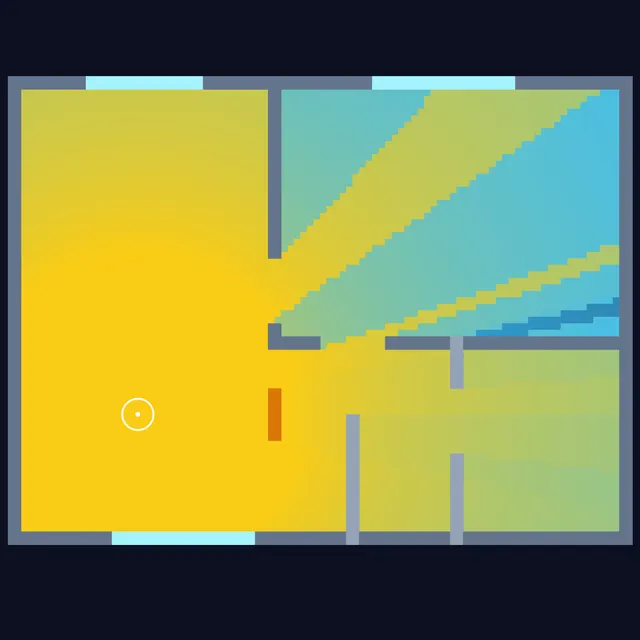
Room Airflow & Smoke follows air through a one-room house seen from above. Wind blows from the left across the yard; windows and a door are gaps in the walls; smoke fills the room at the start and leaves with the air. The air moves as an incompressible fluid computed with Jos Stam's stable fluids (1999): each step carries the air along itself and then removes any squeezing, so as much air leaves every cell as enters it, and no air passes through a wall.
With two windows across the room the wind blows straight through; with one window the air at the opening swirls and little of it is exchanged, so the smoke clears far more slowly. The readout gives the air entering the room per second, per meter of height, and the air changes per hour. If the room were perfectly mixed, smoke would fall as e^(−Qt/V), with Q the airflow and V the room's size, and the chart draws that curve under the measured smoke: the gap shows the corners and eddies the air passes by.
Draw partitions or furniture, compare rooms in the Runs table and export a PNG, video, GIF or CSV. The model has no fire: in a real fire fresh air feeds the flames, and fire-safety researchers advise closing doors.
How to use Room Airflow & Smoke
- Pick a room. Choose One window, Two windows across, Window and door, Fan or No wind. Each preset sets every control in Setup and Model.
- Set the wind. Wind speed sets the wind entering from the left, from 0 to 5 m/s; Opening width sets each window from 0.5 to 2 m; in the Fan room, Fan speed sets the jet the fan blows toward the window.
- Draw the room. Pick Wall and drag in the room to draw partitions or furniture 25 cm wide, or Erase to clear walls, the house's own included. The air flows around them as you draw; Rerun starts again from the first second with your layout, Restart clears it, and Reset returns every setting to its default.
- Read the flow. Blue lines show where the air goes and how fast. The readout gives the smoke left, the air entering the room and the air changes per hour.
- Compare rooms. When 95% of the smoke is gone, or after 10 minutes, the run adds a row to the Runs table with the time and the mean air changes per hour.
- Export. Save a PNG, record 8 seconds, or record the full run. The CSV files hold the smoke left every second and the Runs table, and a share link carries your layout.
Frequently asked questions
Why do two windows clear smoke so much faster than one?
Because the wind needs a way out. With windows on opposite walls, air pushed in at one leaves at the other and carries the smoke with it; with one window, air can only swirl in and out of the same opening. In the model, at a 2 m/s wind, two 1 m windows across the room clear 95% of the smoke in about 2 minutes 20 seconds, while one window still leaves about a third of it after 10 minutes.
What does the dashed curve show?
The smoke a perfectly mixed room would keep: e^(−Qt/V), with Q the measured airflow into the room and V its area times one meter of height. Real air passes by corners and eddies, so the measured smoke falls more slowly than the curve.
Should I open windows in a fire?
No. This model has no fire, and a real fire grows with fresh air. UL's Fire Safety Research Institute advises closing doors: their research found that a closed door can mean the difference between 1,000 and 100 degrees, and between 10,000 and 1,000 ppm of carbon monoxide, in a room during a fire. Get out and call the fire service.
How real is the airflow?
It is a flat slice of air with no turbulence model, so eddies stay steady where real air would mix, and the wind speed, the room and the openings are model settings. It shows where air goes and why openings matter, not the ventilation rate of a particular room.
References
- Stam, J. (1999). Stable fluids. Proceedings of SIGGRAPH 99, 121–128.